Sonic Compass · Mojo Review · Speaker (bookshelf) · Session Review
Microphase Audio Design SAT MK1.1
A compact desktop monitor that never fatigues and pulls real detail out of voices and acoustic material — and shows its size the moment the material goes wide.
A small desktop monitor that gets the things that matter for hours-long nearfield listening right: it never fatigues, it pulls you in emotionally, and it resolves real, named detail. Push it toward wide orchestral or airy electronic material and the compact cabinet shows its limits on warmth and stage width.
- Named, specific detail retrieval for the cabinet size
- Zero mentions of fatigue across three sessions, one running 90 minutes
- Strong PRAT — rhythm and timing named directly, unprompted
- Warm and involving on voices and acoustic material despite a cool tone-colour score
- Bundled with the WiiM Amp Ultra: one box replaces streamer, DAC, and amp
Where it sits
Sonic Compass does not score gear out of ten. Gear and listeners are plotted on the same seven axes, so a review tells you where a product sits — and you can see how far that is from where you sit. A position is a description, not a grade.
- Tone ColourBalanced · 42%
- Texture DetailVery detailed · 82%
- Dynamics JumpPunchy · 76%
- Space & ImagingBalanced · 44%
- Timing & FlowRhythmic · 75%
- Comfort & FatigueVery easy-going · 98%
- Emotional EngagementVery immersive · 93%
Cool on wide-orchestral and airy-electronic material (R.E.M., Filter both mid-20s) — but vocal and acoustic tracks read warm regardless of the number. My Morning Jacket: “terrific warmth to voices, real sense of texture and shape.” Black Pumas: “organ is rich, warm, timbre is so beautiful.”
Named, not vague. Calexico: “piano is great, you can hear the keystroke sounds.” GoGo Penguin: “excellent level of detail in this track, the piano, the backing tracks, production quality all really shine.”
Adrian Belew's 1967 and Black Pumas' Colors both scored 84–86 — crescendos and dynamic swings land with real impact for the cabinet size.
The 210mm cabinet can't produce a wide, deep orchestral stage — but on closer material it images specifically: “the trickle down of the harp starts high above my computer monitor and then ends below” (Calexico); “staging is front and centre, percussion fans out behind the vocalists” (Si*Sé).
PRAT is a recurring, unprompted word in the notes themselves — Si*Sé's Mariposa and Black Pumas' Colors both name it directly as a strength.
Zero mentions of fatigue across three sessions, one running 90 minutes. “Low end is solid, more than good enough for my desktop” (Glass Beams).
“PRAT so good, this is brilliant, drew me in immediately… my body began rocking immediately” (Si*Sé). “Awesome low end, and proper bump and groove, my head is boobin' away, I went to get up and dance” (Sofi Tukker).
Sonic Compass does not grade gear. We plot gear and listeners on the same seven axes — Tone Colour, Texture & Detail, Dynamics & Jump, Space & Imaging, Timing & Flow, Comfort & Fatigue, Emotional Engagement — so a review tells you where a product sits, and you can see how far that is from where you sit. A position is descriptive, never a grade: a cool tone score means “cool”, not “bad”. Fit is compatibility, not quality.
Microphase Audio Design's entry point into its speaker lineup — a compact two-way bookshelf monitor built around a bespoke Audax full-range driver with phase plug and an Audax tweeter, crossing over at 4kHz. This pairing runs it off the WiiM Amp Ultra, an all-in-one streaming amplifier with Dirac Live room correction, at the desktop.
Three sessions, Sept 9–24, 2026, all at the desktop, close-field. Source was Radio Paradise's main, mellow, and global channels — unscripted, hours-long, whatever came up next rather than a curated playlist. 27 tracks were captured; 26 were tagged to a specific song, and 14 were scored across the full seven-axis Compass. 45 timestamped notes were typed live, in the moment, while listening.
Listening journey
Mariposa (en Havana), Si*Sé (Latin lounge) — “PRAT so good, this is brilliant, drew me in immediately. Snappy percussion, the little violin bits, the voices, this just has groove, my body began rocking immediately.” A little further in: “female vocals are rich, potent, and hang in the air perfectly, riding over the rhythm work... staging is front and centre, percussion fans out behind the vocalists.”
Colors, Black Pumas (soul / gospel) — “Organ is rich, warm, timbre is so beautiful, and the man's voice is hauntingly good, soulful, full of emotion, I am pulled in.” By the close of the track: “the gospel aspect of this song matches the intensity and perfection of the tone, the timbre, the PRAT, everything — so engaged, so detailed.”
Clustering Train, The Golden Palominos (the one negative note) — “Not a fan of this song. The recording seems flat compared to other tracks. Vocals are recessed behind the instruments, drums seem to ride over everything.” The only genuinely negative note across all 45 — and it names the recording, not the speaker.
Two Silver Trees, Calexico — “Piano is great, you can hear the keystroke sounds” — then, on the same track: “wonderful strings, a real sense of space and holographic representation... the trickle down of the harp starts high above my computer monitor and then ends below.” The clearest evidence in the whole log that detail and imaging can both be real, at this size, on the right material.
| Track | Position | Note |
|---|---|---|
| Mariposa (en Havana) | 100% | PRAT so good, drew me in immediately, my body began rocking |
| Colors | 100% | So engaged, so detailed, gospel intensity |
| BOBA | 80% | Awesome low end, proper bump and groove |
| World Leader Pretend | 40% | Coolest tone-colour reading in the log — wide orchestral-leaning material |
| Take A Picture | 100% | Singing along, wall of sound velvety and soft |
Critical observations
Where the SAT MK1.1 sits — The shape leans out toward Comfort, Emotional Engagement and Detail, and pulls in on Tone Colour and Space & Imaging. It gives up cabinet-scale warmth and stage width for ease and specificity. If you listen close-field, for hours, and care more about texture than scale, that is a good trade.
Tone Colour — The number says cool (42/100) — but the freeform notes complicate that story. On My Morning Jacket: “there is a terrific warmth to voices, real sense of texture and shape.” On Black Pumas: “organ is rich, warm, timbre is so beautiful.” The lean scores cluster specifically on wide-orchestral and airy-electronic material — R.E.M. and Filter both logged tone warmth in the mid-20s — while anything vocal or acoustic reads warm regardless of the number.
Midbass and Mids — Two direct frequency-band notes, logged live: “punchy not weighty” on midbass in one session, “excellent, thick, snappy and strong” on midbass in another. Mids logged simply as “very very nice”, on Collective Soul's Reunion.
Space & Imaging — The 210mm cabinet can't produce a wide, deep orchestral stage, and the number (44/100) says so plainly. But on closer material it images specifically rather than vaguely: “the trickle down of the harp starts high above my computer monitor and then ends below” (Calexico); “staging is front and centre, percussion fans out behind the vocalists” (Si*Sé). Not a wide stage. A precise one.
Comfort — Zero mentions of fatigue across three sessions, one running 90 minutes straight. “Low end is solid, more than good enough for my desktop” (Glass Beams). Comfort is the single highest-scoring axis in the whole log.
Honest limits — Three sessions, one desktop chain, unscripted Radio Paradise programming rather than a controlled test playlist. No measurement gear used — every position here is listening, logged live, timestamped to the second. Genre performance is inferred from the artists actually played, since Radio Paradise doesn't tag genre per track.
Measured frequency response — A sweep of the SAT MK1.1 from 20Hz to 20kHz. The chart doesn't say how the sweep was taken (microphone distance, gating, smoothing), so read the bottom octave as a guide, not an exact figure.
Redrawn from the measurement below. Shaded band: the flat region from 300Hz to 15kHz.
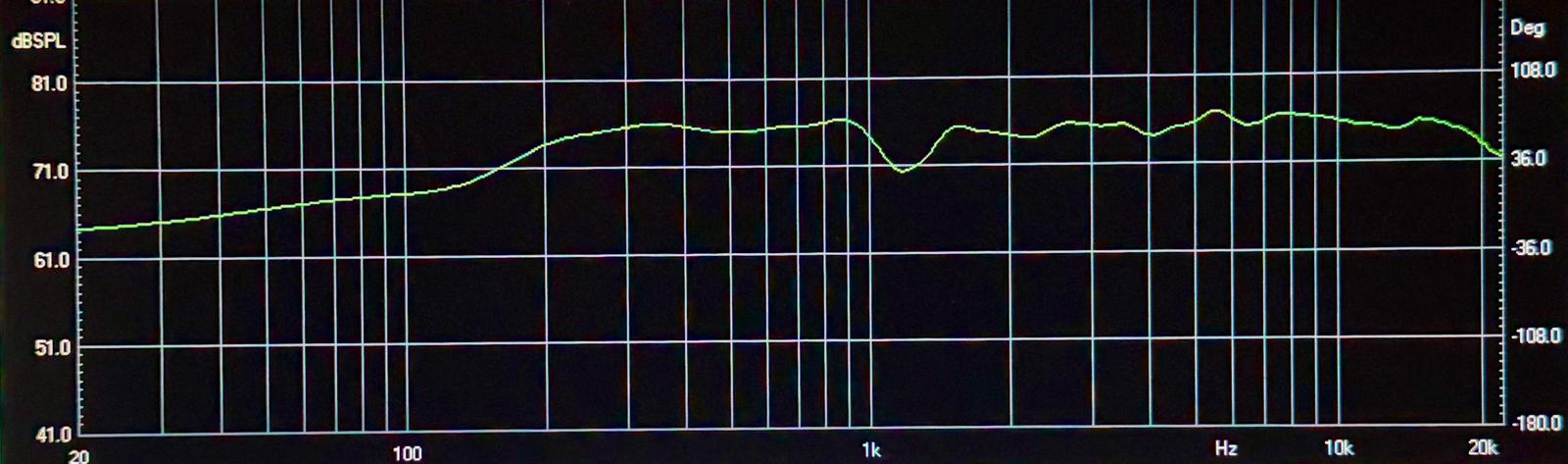
What the curve shows. From about 300Hz to 15kHz the response is unusually even. It stays between roughly 75 and 78dB, within about ±1.5dB, with one exception: a narrow dip of 5–6dB centred near 1.1kHz. Below 300Hz the output falls away gently. It is about 3dB down at 200Hz, 8dB down at 100Hz and 11dB down at 20Hz. Above 15kHz the top octave eases off by 3–4dB. The treble has no peak and sits level with the midrange. At 60Hz the trace is about 9dB below the plateau, a little outside the ±6dB the maker quotes. Without knowing how the sweep was taken, that gap shouldn't be read as contradicting the specification.
How it lines up with the listening notes.
Tone Colour (42, cool). The measurement explains the score, but not in the way "cool" usually implies. The treble isn't lifted. What's missing is the bottom end. With less energy below 200Hz than above it, the overall balance tilts lean, and that's what the tone score picked up.
Warmth on voices. The review already notes a tension between a cool tone score and notes such as “terrific warmth to voices” (My Morning Jacket) and “organ is rich, warm” (Black Pumas). The curve resolves it. The body of a voice and the middle register of an organ sit mostly on the flat plateau, so they keep their warmth. The shortfall is further down, in the octaves that give orchestral and electronic recordings their weight. That's where the coolest readings clustered (R.E.M., Filter).
Midbass (“punchy not weighty”). This was measured, not just perceived. Between 80Hz and 200Hz the response is 3–9dB below the plateau. Attack and timing come through. Mass doesn't.
Mids (“very very nice”). The midrange is the flattest part of the trace. Nothing sticks out, which is usually how a good midrange sounds.
Texture & Detail (82). The detail comes from treble that's extended and level, not boosted. That's why the notes name specifics like keystrokes, drum-stick clicks and individual harmonies without ever mentioning glare or sibilance.
Comfort & Fatigue (98). The likeliest reason is what the curve doesn't have: no peak between 2kHz and 8kHz, where listening fatigue usually starts, and a gentle roll-off above 15kHz. The 1.1kHz dip may soften the upper midrange slightly, but at 5–6dB and narrow it contributes little at most, and the listening notes never picked it out.
Space & Imaging (44). A single on-axis measurement shows nothing about stereo imaging or dispersion, so this axis rests on listening alone.
Scale on orchestral material. The limit the review describes on wide orchestral recordings is mostly the bottom octaves. A 210mm cabinet can't produce 20–60Hz at full level, and the curve confirms it.
In short: the measurement doesn't overturn what was heard. It explains it: a flat, even speaker from the lower midrange up, with a bass shelf that makes the overall balance read lean.
Frequency balance
“Punchy not weighty” (Sept 9 session). “Excellent, thick, snappy and strong” (Sept 10 session). Two separate in-the-moment observations, logged directly.
“Very very nice” — logged directly during the Sept 24 session, on Collective Soul's Reunion.
- Mariposa (en Havana)Si*Sé
- ColorsBlack Pumas
- Take A PictureFilter
- Two Silver TreesCalexico
- The Way that He SingsMy Morning Jacket
- BOBASofi Tukker
- MahalGlass Beams
- Clustering TrainThe Golden Palominos
- World Leader PretendR.E.M.
- Mount AnalogueGoGo Penguin
- Impedance
- 4 ohms nominal
- Sensitivity
- 90dB/1W/1m
- Frequency Range
- 60Hz-25kHz ±6dB
A small desktop monitor that gets the things that matter for hours-long nearfield listening right: it never fatigues, it pulls you in emotionally, and it resolves real, named detail. Push it toward wide orchestral or airy electronic material and the compact cabinet shows its limits on warmth and stage width.
<p><strong>Buy it if</strong>… you listen at the desktop, close-field, for hours at a stretch; your library leans soul, singer-songwriter, world/percussive or groove-driven; you value hearing texture and detail over cabinet-scale warmth; and you want one box (the WiiM Amp Ultra bundle) to replace a separate streamer, DAC and amp.</p><p><strong>Skip it if</strong>… you need a wide, deep orchestral stage or listen mostly to airy electronic and wide-mix material — the 210mm cabinet and 60Hz floor genuinely can't deliver that scale. This is a specialist for close, detailed, groove-forward listening, not a wide-stage all-rounder.</p>