Sonic Compass · Mojo Review · DAC/Amp · Session Review
SMSL C200 Pro
A compact desktop DAC and headphone amp with a built-in power supply that sounded neutral, clean and quiet to me on everything from planars to IEMs, with a decent stage for the price.
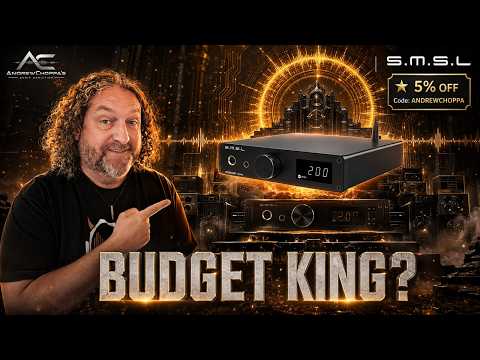
A tiny, quiet, neutral DAC and amp with a built-in power supply that drove every headphone and IEM I tried with headroom to spare. Stage is decent rather than holographic, and the front menu is poor.
- Neutral and clean
- Dead-silent noise floor
- Drives planars and IEMs with headroom
- Built-in power supply and remote
- Good width for the price
Where it sits
Sonic Compass does not score gear out of ten. Gear and listeners are plotted on the same seven axes, so a review tells you where a product sits — and you can see how far that is from where you sit. A position is a description, not a grade.
- Tone ColourBalanced · 50%
- Texture DetailVery detailed · 80%
- Dynamics JumpPunchy · 70%
- Space & ImagingSpacious · 62%
- Timing & FlowBalanced · 55%
- Comfort & FatigueEasy-going · 60%
- Emotional EngagementBalanced · 58%
Neutral. No tube-like warmth and no icy treble. Placed in the middle on this scale (high = warm). Against the Q1 the C200 Pro has a little more treble presence.
Resolution, clarity and micro detail excellent on the HE1000 Unveiled and both IEMs, with no sibilance or harshness.
Punchy, with nice mid-bass punch and a punchy start on the IEMs. Sub-bass rolls off. 'Punches very well' even against gear that costs more.
Good width and imaging you can pinpoint, but a little congested next to bigger amps and not 3D or holographic. The Q1 with Burson op amps was wider.
Near the middle with thin evidence. He says nothing about timing directly; only that it is clean and punchy.
Slightly above the middle with thin evidence: no sibilance or harshness, a dead-silent noise floor, and no gain switch. No long-session remark in the video.
Near the middle with thin evidence. He found it fun and says the headphones 'sounded great', but gives no deeper emotional account.
Sonic Compass does not grade gear. We plot gear and listeners on the same seven axes, so a review tells you where a product sits and you can see how far that is from where you sit.
The SMSL C200 Pro is a small desktop DAC and headphone amplifier. The unit was sent to me for review. I ran it by USB from my PC, streaming from Tidal, and I did not use its Bluetooth, its gaming mode or its balanced line outputs.
Listening journey
ZMF Tessidera — Driven very well. I sat at about 75 to 80 on the volume pot with plenty of headroom left, and they sounded great. They did not sound as good as my US$2,500 Aune A17, but for about $200 they sounded bloody good, and you also get the power supply and the DAC in the box.
HiFiMAN HE1000 Unveiled — Resolution and clarity are excellent, with good punchy bass and a natural timbre on vocals, guitars and piano. I was down at about 65 on the pot with plenty of headroom. Imaging is well spaced and staging is quite wide. If you do not compare it to anything, you do not feel you are missing anything.
Two IEMs — With a lower-priced pair (around $100) I was at about 50 on the pot and they sounded fantastic, with competent staging, clear micro detail and no sibilance or harshness. A synth harpsichord came through punchy, clean and as lifelike as a synth harpsichord can be. A male voice was natural, powerful and close, without being forward, honky or shouty. The pricier pair, about five times the cost, told a similar story with more detail and resolution, which is what I would expect of better IEMs.
Noise — The noise floor is zero. Press stop and you hear nothing, on every headphone I tried. There is no gain switch, so volume is set on the knob alone.
| Track | Position | Note |
|---|---|---|
| One | 60% | More through the back of the head than on the Q1 with Burson op amps |
Critical observations
Where the C200 Pro sits — Neutral. It does not add tube-like warmth or an icy, sharp treble. Music that is badly recorded sounds bad on it; it cannot polish a poor recording. Resolution is excellent and imaging is razor sharp by the standards of the price.
Stage and imaging — Width is quite decent, and imaging is good enough to pinpoint instruments and sounds in the space. It is a little congested next to bigger amps and does not give the 3D, holographic stage of a US$1,000 discrete stack, but for what it is, the lateral staging is good.
Bass and mids — Punchy, with a nice mid-bass punch on a six-string and a bass guitar that does not go ocean-deep. Mids are natural. Sub-bass rolls off, which I expect from a $200 amp and from IEMs that do not go seriously low.
Against the Q1 DAC and amp (brand to confirm), about US$260 — The Q1 is a flashy little unit with two sets of DAC chips and I have fitted Burson V7 Classic op amps. The C200 Pro has a bit more treble presence, not necessarily higher, just more of it, and slightly more forward mids. The Q1 has a touch more bass quantity, not deeper, and a slightly wider, more holographic stage. On Metallica's One the sound starts further to the left and goes around behind my head more on the Q1, and more through the back of my head on the C200 Pro. With the Q1's stock op amps swapped back in, staging, imaging, dynamics and punch were slightly reduced and the two made an almost identical listen. The Q1 gives more room to tune with op amps but you have to take the top off, while the C200 Pro is tiny, powerful and punches very well.
Handling — The internal power supply and the full-size remote are real plusses. The push-button menu on the front is awful, so keep the remote handy. The remote arrived with no batteries in it, which annoyed me. Per the maker the DAC uses an ESS ES9039Q2M chip with an XMOS XU316 USB receiver, and the amp has four OPA1612A op amps.
Read this against your own profile — I want a clean, neutral all-in-one that is quiet, drives my headphones and IEMs with room to spare, and does not take much desk space. If that is you, this fits. If you want a big holographic stage or a warm sound, look elsewhere.
Honest limits — The unit was supplied to me. By ear only, with no measurements of my own, from one source and one PC. I did not test Bluetooth, the gaming (UAC 1.0) mode, or feeding studio monitors from the line outputs. The comparison was against a Q1 that I had modified, and the Aune A17 comparison is across very different price classes. I made no remark about timing or fatigue, so Timing and Comfort sit near the middle with little evidence behind them. Specs are the maker's, via an authorised distributor.
- OneMetallica
- Driver Configuration
- Desktop DAC and headphone amplifier, ESS ES9039Q2M DAC chip, XMOS XU316 USB receiver, four OPA1612A op amps
- Driver Details
- Headphone output power per channel: 3W into 16 ohms, 1.5W into 32 ohms, 350mW into 150 ohms, 170mW into 300 ohms, 85mW into 600 ohms; gain +9.5dB (SMSL specifications via Linsoul)
- Weight
- 510g
- Build Materials
- Metal case with gold-plated input and output connectors
- Cable Connectors
- Outputs: 6.35mm headphone, 4.4mm headphone, TRS and RCA line out. Inputs: USB, optical, coaxial, Bluetooth 5.1 (LDAC, aptX HD, aptX, AAC, SBC)
- Isolation Leakage
- Not applicable
- Power Requirements
- Built-in power supply, mains AC input
- Accessories
- Remote control, Bluetooth antenna, USB cable, AC power cord, user manual, warranty card
- Build Quality Notes
- Specs (SMSL via Linsoul): USB PCM up to 768kHz and DSD up to DSD512, MQA decoding; headphone out THD+N 0.00009% (-120dB), SNR 125dB, dynamic range 129dB on TRS. 139 x 32 x 147.5mm. Price: US$199 (Linsoul listing). Photos: Linsoul listing images of the SMSL product.
A tiny, quiet, neutral DAC and amp with a built-in power supply that drove every headphone and IEM I tried with headroom to spare. Stage is decent rather than holographic, and the front menu is poor.
<p><strong>Buy it if</strong>… you want an all-in-one desktop DAC and amp for about US$200 with a built-in power supply; you like a clean, neutral, quiet presentation; or you want something small that handles both planars and IEMs.</p><p><strong>Skip it if</strong>… you want a big, three-dimensional stage or added warmth; you dislike menu navigation by remote; or you want a gain switch for very sensitive IEMs.</p>