Sonic Compass · Mojo Review · IEM (universal) · Session Review
SoundPEATS H3
A true wireless set that punches well above its price: deep controlled bass, forward vocals and a vast stage, with an EQ that lets you shape it.
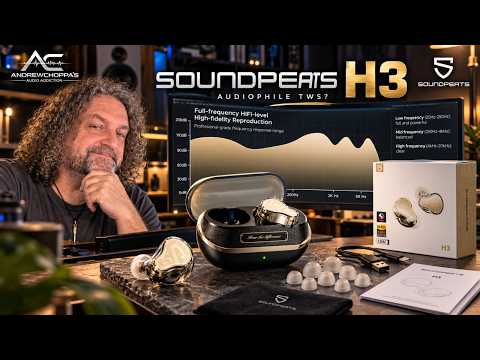
This genuinely shocked me. For the price the H3 delivers exceptional raw audio performance: deep controlled bass, forward vocals, clear detail and a vast stage, with an EQ that lets you shape it however you like. Bluetooth isn't at wired quality yet, but it's not far behind.
- Deep, controlled bass that stays clean on fast metal
- Forward, powerful vocals with the bass still in check
- A vast stage and very good imaging for the price
- Clear detail without sibilance or fatigue at volume
- A flexible EQ that makes the hardware easy to tune
Where it sits
Sonic Compass does not score gear out of ten. Gear and listeners are plotted on the same seven axes, so a review tells you where a product sits — and you can see how far that is from where you sit. A position is a description, not a grade.
- Tone ColourWarm · 70%
- Texture DetailDetailed · 70%
- Dynamics JumpVery punchy · 85%
- Space & ImagingSpacious · 78%
- Timing & FlowRhythmic · 75%
- Comfort & FatigueVery easy-going · 83%
- Emotional EngagementVery immersive · 88%
Warm out of the box (high = warm on this scale). Next to the U-XUE there is a little less treble energy, but it's never dull. A treble-boost preset closes the gap if you prefer it brighter.
Very clear and very detailed up top without hurting the mids. Violins on the Vivaldi were crisp and clean. The U-XUE resolves slightly more, but the gap is small.
Drum hits are fast and snappy. Frenetic metal is where lots of buds collapse, and the H3 stayed punchy, clean and powerful through Vanishing Point and Electric Callboy.
A vast stage for true wireless, with wide instrument separation and very good imaging for the price. Hendrix was placed around and outside my head.
Fast, tight and well controlled. The synth bass beat on Everytime We Touch was heart-pumping and clean.
They fit beautifully and I wore them for four hours. Played loud, the Vivaldi violins showed no sibilance and no fatigue.
“Mr. Talk's chorus comes in and I just want to throw my fists in the air.” Every genre I threw at them was exciting to listen to.
Sonic Compass does not grade gear. We plot gear and listeners on the same seven axes, so a review tells you where a product sits and you can see how far that is from where you sit.
I'm a wired listener and I'm wary of true wireless. Too often it means compressed codecs and Bluetooth gremlins. SoundPEATS sent me the H3 after I contacted them, following a viewer comment on one of my earlier reviews. Thanks to Susie for sending them out. SoundPEATS did not see this review or have any say in it before it was published.
All listening was on a Samsung Galaxy Z Fold7 over LDAC, on the default Classic EQ unless I say otherwise. I expected another forgettable pair of buds. I didn't get one.
Listening journey
Bring Me the Night, Vanishing Point (symphonic metal) — A big, bombastic song with huge orchestration, heavy riffs and massive choruses. The bass sits on the ocean floor, with and without EQ, and the H3 handles the chaos without collapsing. Drum hits are fast and snappy. Punchy, clean and powerful.
Harder at Breaks, TALK (soulful ballad) — Clean and detailed, with a rich, natural bass drum. “Mr. Talk's chorus comes in and I just want to throw my fists in the air.” Mids and upper mids are natural and full, with good attack and body. The stage wraps all the way around me and each sound is easy to pinpoint.
Spring, Vivaldi (orchestral) — Violins are crisp and clean with zero fatigue. I turned it up loud and it stayed snappy and punchy, with no sibilance. The harpsichord sits underneath and the cellos add depth and weight. The timbre is natural and organic, like sitting in the hall with the orchestra, on the default EQ.
Everytime We Touch, Electric Callboy (metal / EDM crossover) — The synth bass beat is huge, clean and well controlled. Clean vocals are forward and natural, and the drums and guitars are lively and detailed. An exciting party anthem, and the H3 does it complete justice.
All Along the Watchtower, Jimi Hendrix (classic rock) — The perfect example of diffuse placement and separation. Sounds are thrown around and outside my head. I used it with Everytime We Touch for the comparison with the Unique Melody U-XUE below.
| Track | Position | Note |
|---|---|---|
| Bring Me the Night | 92% | Ocean-floor bass, fast snappy drums, handles the chaos |
| Harder at Breaks | 94% | Fists in the air, natural full mids, stage all around |
| Spring (The Four Seasons) | 90% | Crisp violins, zero fatigue, natural hall tone |
| Everytime We Touch | 92% | Huge controlled synth bass, lively detailed drums |
| All Along the Watchtower | 88% | Placement thrown around and outside the head |
Critical observations
Where the H3 sits — The shape leans out toward Emotional Engagement, Dynamics & Jump and Comfort, and sits warm on Tone Colour. It gives up a small amount of resolution against much dearer sets. Its stage is bigger than I expected from true wireless.
Bass — Deep with and without EQ, and controlled rather than muddy. Even on the neutral setting it has more bass weight and power than the much dearer set I compared it with.
Mids and vocals — The bass doesn't come at the expense of the midrange. Vocals aren't recessed at all; they're forward and powerful.
Treble and detail — Very clear and very detailed, with no sibilance or fatigue even played loud. In a straight comparison the U-XUE resolves a little more, but you need to listen side by side to hear it.
Stage and imaging — Vast, with wide instrument separation and imaging that is very good for the price. Hendrix was thrown around and well outside my head.
H3 vs Unique Melody U-XUE — The U-XUE costs about three times as much. It has a touch more treble detail and resolution, so technically it is slightly superior, but the H3 isn't far behind. The H3's bass is beefier and more powerful, even on the neutral EQ. Staging and separation are similar, and both place images all around and outside my head. The H3 is warmer, with a little less treble energy, but it's still exciting, and it fits better inside my ears, which is my preference. The U-XUE gets the medal for technical detail. Overall I'd choose the H3 for fit, style, price and sheer excitement, and it costs a third as much.
Read this against your own profile — I sit toward the bright, detail-first end of the compass. The H3 is warm out of the box, and that is the biggest gap between us. It's easy to close: I made two presets, one with extra bass and one with extra treble, and used both a lot. Detail and stage are my top priorities, and the H3 comes close on both. If you like a warm, dynamic sound it is close to a bullseye on Classic. If you like it bright and detail-first, budget ten minutes in the EQ for a treble lift. Even then a dearer set will resolve a little more, and whether that is worth three times the price is your call.
App and daily use — The PeatsAudio app is smart looking and shows everything I need. The ANC options (Adaptive, Indoor, Outdoor and Traffic, plus Normal and two transparency modes) are a real plus for commuters. There are twelve EQ presets, including Rock, Bass, Electronic, Classical and Folk, and each makes a significant difference. I stuck with the default, Classic. Touch controls can be switched off, and I did. Game mode cuts latency to 60ms. Calls were perfectly clear.
What didn't work — My Samsung Galaxy Z Fold7 didn't suit the app. It wouldn't run in split screen or on the unfolded screen, so I had to use the single cover screen. The adaptive EQ hearing test never ran: the animation kept flashing the buds in and out of the head and no test tones played. I found others reporting the same, reinstalled the app and tried every workaround, and nothing worked. I'm following it up with SoundPEATS and will report back. Connecting two devices at once drops LDAC, which the U-XUE also does. My phone offers LDAC but not aptX Adaptive or aptX Lossless, so I haven't heard either.
Honest limits — ANC was barely tested. I live on a very quiet street and it was calm on the day, so I couldn't test the claimed 55dB. It worked in every mode around the house and shut out my three demonic dogs for a while. SoundPEATS's own battery table gives 5 hours per charge on LDAC (the 7 hours is for SBC and AAC); after four hours on LDAC the app showed about half charge, but I didn't run it down, so neither that nor the 37-hour case figure is checked. Most listening was on Classic, with some on my own presets that I didn't always record. The U-XUE comparison was by ear and wasn't level-matched. I took no measurements.
- Bring Me the NightVanishing Point
- Harder at BreaksTALK
- Spring (The Four Seasons)Vivaldi
- Everytime We TouchElectric Callboy
- All Along the WatchtowerJimi Hendrix
- Driver Configuration
- 1DD + 2BA tribrid
- Driver Details
- 12mm composite dynamic driver (bass, mid-bass) and dual balanced armatures (mid-high, high)
- Weight
- About 6g per earbud (SoundPEATS)
- Build Materials
- Clear shell with gold detailing; smoky black charging case
- Cable Connectors
- True wireless. Qualcomm QCC3091, Bluetooth 5.4, LDAC, aptX Adaptive, aptX Lossless. Charging via USB-C
- Isolation Leakage
- Hybrid ANC with six microphones, claimed up to 55dB; Adaptive, Indoor, Outdoor and Traffic modes
- Accessories
- Charging case, extra spare tips, USB-A to USB-C cable, setup guide, stickers
- Build Quality Notes
- Battery: up to 7h (5h on LDAC, per SoundPEATS's table), 37h with case. IPX5. Launched September 2025 at US$129 RRP. Photos: SoundPEATS.
This genuinely shocked me. For the price the H3 delivers exceptional raw audio performance: deep controlled bass, forward vocals, clear detail and a vast stage, with an EQ that lets you shape it however you like. Bluetooth isn't at wired quality yet, but it's not far behind.
<p><strong>Buy it if</strong>… you want true wireless that keeps up with metal, rock, EDM and orchestral music; you like big bass without losing the mids; stage and separation matter to you; you're happy to spend ten minutes in the EQ; and you want a set that looks like proper IEMs and fits well.</p><p><strong>Skip it if</strong>… you need a seamless app on a folding phone; you need flawless dual-device LDAC; you want the last bit of resolution and will pay three times as much for it; or you need proven ANC on a plane, which I couldn't test.</p><p>Highly recommended by me if you need quality Bluetooth on the go. Until next time: peace, and stay metal.</p>